---
title: "Session 6"
description: "Single Source Shortest Path Algorithm"
image: "https://syntax.theether.in/og.png"
---
> Documentation Index
> Fetch the complete documentation index at: https://syntax.theether.in/llms.txt
> Use this file to discover all available pages before exploring further.
# Session 6
This session introduces shortest path problems in weighted graphs. The main idea is to start from one source vertex and compute the minimum distance to every other vertex. This is useful in routing, maps, network design, and any problem where we need the cheapest or shortest route from one point to many destinations.
## Objectives
- Understand single-source shortest path problems.
- Apply Dijkstra's algorithm when all edge weights are non-negative.
- Identify why negative edge weights require a different algorithm such as Bellman-Ford.
## Concept
A single-source shortest path algorithm finds the minimum distance from one starting vertex to every other vertex in a weighted graph.
| Algorithm | Suitable When |
| --------- | ------------- |
| Dijkstra | All edge weights are zero or positive |
| Bellman-Ford | Negative edge weights may exist |
## Standard Dijkstra Approach
1. Set the source distance to `0` and all other distances to infinity.
2. Pick the unvisited vertex with the smallest known distance.
3. Relax all outgoing edges from that vertex.
4. Repeat until all vertices are processed.
## Standard Bellman-Ford Approach
1. Set the source distance to `0` and all other distances to infinity.
2. Relax every edge `V - 1` times.
3. Run one more relaxation pass to detect a negative cycle.
## Common statement
> It's for all three questions in this sessions.
Implement Dijkstra’s algorithm to find the single source shortest path algorithm from different sources to the rest of nodes in the following graph and show allthe intermediate processes:
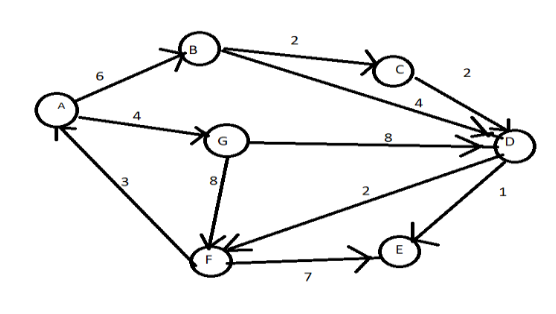 ## Dijkstra's Algorithm Implementation
> This code also includes solutions for all the three question as code and text part is explained standalone. This is done because of implementation requirement for code.
### Python
```python title="dijkstra-algo.py" file=/public/code/mcs-216/section-1/session-6/algorithm/d.py
```
### C
```c title="dijkstra-algo.c" file=/public/code/mcs-216/section-1/session-6/algorithm/d.c
```
### Rust
```rust title="dijkstra-algo.rs" file=/public/code/mcs-216/section-1/session-6/algorithm/d.rs
```
## Question 1
### Problem Statement
Find the shortest path from `A` to the rest of vertices.
### Explanation / Approach
Use Dijkstra's algorithm if all edge weights in the graph are non-negative. Start with distance of `A = 0`, mark all other vertices as infinity, and repeatedly relax the nearest unvisited vertex.
### Answer
#### Initial State
```js
Distances: A=0, B=∞, C=∞, D=∞, E=∞, F=∞, G=∞
Visited: {}
```
#### Iteration 1: Process A (dist=0)
```js
Neighbors: B(6), G(4)
Update: B=0+6=6, G=0+4=4
Distances: A=0, B=6, C=∞, D=∞, E=∞, F=∞, G=4
Visited: {A}
```
#### Iteration 2: Process G (dist=4) ← Minimum unvisited
```js
Neighbors: D(8), F(8)
Update: D=4+8=12, F=4+8=12
Distances: A=0, B=6, C=∞, D=12, E=∞, F=12, G=4
Visited: {A, G}
```
#### Iteration 3: Process B (dist=6) ← Minimum unvisited
```js
Neighbors: C(2), D(4)
Update: C=6+2=8, D=min(12, 6+4)=10
Distances: A=0, B=6, C=8, D=10, E=∞, F=12, G=4
Visited: {A, G, B}
```
#### Iteration 4: Process C (dist=8) ← Minimum unvisited
```js
Neighbors: D(2)
Update: D=min(10, 8+2)=10 (no change)
Distances: A=0, B=6, C=8, D=10, E=∞, F=12, G=4
Visited: {A, G, B, C}
```
#### Iteration 5: Process D (dist=10) ← Minimum unvisited
```js
Neighbors: F(2), E(1)
Update: F=min(12, 10+2)=12 (no change), E=10+1=11
Distances: A=0, B=6, C=8, D=10, E=11, F=12, G=4
Visited: {A, G, B, C, D}
```
#### Iteration 6: Process E (dist=11) ← Minimum unvisited
```js
Neighbors: (none that improve distances)
Distances: A=0, B=6, C=8, D=10, E=11, F=12, G=4
Visited: {A, G, B, C, D, E}
```
#### Iteration 7: Process F (dist=12) ← Last unvisited
```js
Neighbors: A(3), E(7)
Both already visited, no updates
Final: A=0, B=6, C=8, D=10, E=11, F=12, G=4
```
#### Final Answer
```js
A→A: 0 (Path: A)
A→B: 6 (Path: A→B)
A→C: 8 (Path: A→B→C)
A→D: 10 (Path: A→B→D)
A→E: 11 (Path: A→B→D→E)
A→F: 12 (Path: A→G→F or A→B→D→F)
A→G: 4 (Path: A→G)
```
## Question 2
### Problem Statement
Find the shortest path from `B` to the rest of nodes.
### Explanation / Approach
The method is the same as Question 1, but the source vertex changes to `B`. The initial distance table should therefore start with `B = 0` and all other vertices as infinity.
### Answer
#### Initial State:
```js
Distances: A=∞, B=0, C=∞, D=∞, E=∞, F=∞, G=∞
```
#### Iteration 1: Process B (dist=0)
```js
Update: C=2, D=4
Distances: A=∞, B=0, C=2, D=4, E=∞, F=∞, G=∞
```
#### Iteration 2: Process C (dist=2)
```js
Update: D=min(4, 2+2)=4
Distances: A=∞, B=0, C=2, D=4, E=∞, F=∞, G=∞
```
#### Iteration 3: Process D (dist=4)
```js
Update: F=4+2=6, E=4+1=5
Distances: A=∞, B=0, C=2, D=4, E=5, F=6, G=∞
```
#### Iteration 4: Process E (dist=5)
```js
No updates
```
#### Iteration 5: Process F (dist=6)
```js
Update: A=6+3=9, E=min(5, 6+7)=5
Distances: A=9, B=0, C=2, D=4, E=5, F=6, G=∞
```
#### Iteration 6: Process A (dist=9)
```js
Update: B=min(0, 9+6)=0, G=9+4=13
Distances: A=9, B=0, C=2, D=4, E=5, F=6, G=13
```
#### Iteration 7: Process G (dist=13)
```js
Update: D=min(4, 13+8)=4, F=min(6, 13+8)=6
Final: A=9, B=0, C=2, D=4, E=5, F=6, G=13
```
#### Final Answer
```js
B→A: 9 (Path: B→D→F→A)
B→B: 0 (Path: B)
B→C: 2 (Path: B→C)
B→D: 4 (Path: B→D)
B→E: 5 (Path: B→D→E)
B→F: 6 (Path: B→D→F)
B→G: 13 (Path: B→D→F→A→G)
```
## Question 3
### Problem Statement
Find the shortest path from `A` to the rest of vertices when there are negative weights `-8` between `G` and `F` and `-3` between `F` and `A`.
### Explanation / Approach
Dijkstra's algorithm should not be used when negative edge weights exist. For this case, use Bellman-Ford reasoning because it can handle negative edges and can also detect negative cycles.
### Answer
> CRITICAL ISSUE: Dijkstra's algorithm FAILS with negative weights
#### Why it fails:
- Dijkstra marks vertices as "visited" permanently
- It assumes once visited, the shortest path is found
- Negative edges can create shorter paths through already-visited vertices
- This violates Dijkstra's greedy assumption
#### Example of failure:
```js
With G→F=-8 and F→A=-3:
Path A→G→F→A creates a cycle: 4 + (-8) + (-3) = -7
This creates a NEGATIVE CYCLE!
You can loop infinitely to reduce distance.
```
## Viva Questions
- Why does Dijkstra fail with negative edge weights?
- What is edge relaxation?
- How does Bellman-Ford detect a negative cycle?
Source: https://syntax.theether.in/mcs-216/section-1/session-6/index.mdx
## Dijkstra's Algorithm Implementation
> This code also includes solutions for all the three question as code and text part is explained standalone. This is done because of implementation requirement for code.
### Python
```python title="dijkstra-algo.py" file=/public/code/mcs-216/section-1/session-6/algorithm/d.py
```
### C
```c title="dijkstra-algo.c" file=/public/code/mcs-216/section-1/session-6/algorithm/d.c
```
### Rust
```rust title="dijkstra-algo.rs" file=/public/code/mcs-216/section-1/session-6/algorithm/d.rs
```
## Question 1
### Problem Statement
Find the shortest path from `A` to the rest of vertices.
### Explanation / Approach
Use Dijkstra's algorithm if all edge weights in the graph are non-negative. Start with distance of `A = 0`, mark all other vertices as infinity, and repeatedly relax the nearest unvisited vertex.
### Answer
#### Initial State
```js
Distances: A=0, B=∞, C=∞, D=∞, E=∞, F=∞, G=∞
Visited: {}
```
#### Iteration 1: Process A (dist=0)
```js
Neighbors: B(6), G(4)
Update: B=0+6=6, G=0+4=4
Distances: A=0, B=6, C=∞, D=∞, E=∞, F=∞, G=4
Visited: {A}
```
#### Iteration 2: Process G (dist=4) ← Minimum unvisited
```js
Neighbors: D(8), F(8)
Update: D=4+8=12, F=4+8=12
Distances: A=0, B=6, C=∞, D=12, E=∞, F=12, G=4
Visited: {A, G}
```
#### Iteration 3: Process B (dist=6) ← Minimum unvisited
```js
Neighbors: C(2), D(4)
Update: C=6+2=8, D=min(12, 6+4)=10
Distances: A=0, B=6, C=8, D=10, E=∞, F=12, G=4
Visited: {A, G, B}
```
#### Iteration 4: Process C (dist=8) ← Minimum unvisited
```js
Neighbors: D(2)
Update: D=min(10, 8+2)=10 (no change)
Distances: A=0, B=6, C=8, D=10, E=∞, F=12, G=4
Visited: {A, G, B, C}
```
#### Iteration 5: Process D (dist=10) ← Minimum unvisited
```js
Neighbors: F(2), E(1)
Update: F=min(12, 10+2)=12 (no change), E=10+1=11
Distances: A=0, B=6, C=8, D=10, E=11, F=12, G=4
Visited: {A, G, B, C, D}
```
#### Iteration 6: Process E (dist=11) ← Minimum unvisited
```js
Neighbors: (none that improve distances)
Distances: A=0, B=6, C=8, D=10, E=11, F=12, G=4
Visited: {A, G, B, C, D, E}
```
#### Iteration 7: Process F (dist=12) ← Last unvisited
```js
Neighbors: A(3), E(7)
Both already visited, no updates
Final: A=0, B=6, C=8, D=10, E=11, F=12, G=4
```
#### Final Answer
```js
A→A: 0 (Path: A)
A→B: 6 (Path: A→B)
A→C: 8 (Path: A→B→C)
A→D: 10 (Path: A→B→D)
A→E: 11 (Path: A→B→D→E)
A→F: 12 (Path: A→G→F or A→B→D→F)
A→G: 4 (Path: A→G)
```
## Question 2
### Problem Statement
Find the shortest path from `B` to the rest of nodes.
### Explanation / Approach
The method is the same as Question 1, but the source vertex changes to `B`. The initial distance table should therefore start with `B = 0` and all other vertices as infinity.
### Answer
#### Initial State:
```js
Distances: A=∞, B=0, C=∞, D=∞, E=∞, F=∞, G=∞
```
#### Iteration 1: Process B (dist=0)
```js
Update: C=2, D=4
Distances: A=∞, B=0, C=2, D=4, E=∞, F=∞, G=∞
```
#### Iteration 2: Process C (dist=2)
```js
Update: D=min(4, 2+2)=4
Distances: A=∞, B=0, C=2, D=4, E=∞, F=∞, G=∞
```
#### Iteration 3: Process D (dist=4)
```js
Update: F=4+2=6, E=4+1=5
Distances: A=∞, B=0, C=2, D=4, E=5, F=6, G=∞
```
#### Iteration 4: Process E (dist=5)
```js
No updates
```
#### Iteration 5: Process F (dist=6)
```js
Update: A=6+3=9, E=min(5, 6+7)=5
Distances: A=9, B=0, C=2, D=4, E=5, F=6, G=∞
```
#### Iteration 6: Process A (dist=9)
```js
Update: B=min(0, 9+6)=0, G=9+4=13
Distances: A=9, B=0, C=2, D=4, E=5, F=6, G=13
```
#### Iteration 7: Process G (dist=13)
```js
Update: D=min(4, 13+8)=4, F=min(6, 13+8)=6
Final: A=9, B=0, C=2, D=4, E=5, F=6, G=13
```
#### Final Answer
```js
B→A: 9 (Path: B→D→F→A)
B→B: 0 (Path: B)
B→C: 2 (Path: B→C)
B→D: 4 (Path: B→D)
B→E: 5 (Path: B→D→E)
B→F: 6 (Path: B→D→F)
B→G: 13 (Path: B→D→F→A→G)
```
## Question 3
### Problem Statement
Find the shortest path from `A` to the rest of vertices when there are negative weights `-8` between `G` and `F` and `-3` between `F` and `A`.
### Explanation / Approach
Dijkstra's algorithm should not be used when negative edge weights exist. For this case, use Bellman-Ford reasoning because it can handle negative edges and can also detect negative cycles.
### Answer
> CRITICAL ISSUE: Dijkstra's algorithm FAILS with negative weights
#### Why it fails:
- Dijkstra marks vertices as "visited" permanently
- It assumes once visited, the shortest path is found
- Negative edges can create shorter paths through already-visited vertices
- This violates Dijkstra's greedy assumption
#### Example of failure:
```js
With G→F=-8 and F→A=-3:
Path A→G→F→A creates a cycle: 4 + (-8) + (-3) = -7
This creates a NEGATIVE CYCLE!
You can loop infinitely to reduce distance.
```
## Viva Questions
- Why does Dijkstra fail with negative edge weights?
- What is edge relaxation?
- How does Bellman-Ford detect a negative cycle?
Source: https://syntax.theether.in/mcs-216/section-1/session-6/index.mdx